News
Proving Social Media Drives Sales: A Data-Driven Guide for Skeptical Brands
Every brand wants to know the same thing: does social media actually drive sales, or are we just chasing likes while revenue stays flat? For direct-to-consumer e-commerce brands, the answer is often a clear yes. But for everyone else, the picture gets murky fast. Maybe someone discovers your product on Instagram, then buys it in a store three weeks later. Maybe they scroll past your TikTok, forget about it, and then purchase after seeing a friend use it. The customer journey is rarely a straight line, and attribution roadblocks are real.
The good news? You can move beyond vanity metrics and prove social impact with the right approach. It just takes some creative problem-solving and a willingness to bridge the gaps between platforms and purchases.
Why Likes, Followers, and Impressions Fall Short
Too many brands stop at engagement metrics. Likes, shares, comments, and follower counts tell you that people saw and reacted to your content. They do not tell you whether that content influenced any actual behavior. Did someone who saw your post become more likely to consider your brand or make a purchase? That is the question that matters.
The real work involves connecting social activity to what happens next. It means asking whether someone exposed to your brand on social is more likely to buy than someone who was not. That is where things get interesting, and where a little creativity goes a long way.
Start With the Right Question
At the beginning of any social strategy, we always ask clients a simple question: “Fast forward one year from now, what does success look like?” We then have them rate, on a scale of one to five, how much they want to drive awareness, engagement, consideration, or purchase. Not surprisingly, most clients give a five to every single metric. When we dig deeper, it becomes clear that purchase is the ultimate goal, and they are simply hoping that awareness and engagement will naturally lead there.
That hope is not a strategy. So we have developed a few different ways to measure whether social is actually moving the needle on sales.
Approach 1: On-Platform Brand Lift Studies
Most major social platforms offer brand lift studies, including Meta, TikTok, Reddit, YouTube, and Snapchat. When people hear “brand lift,” they usually think of awareness. For well-known brands, the pushback is fair: if everyone already knows us, how much lift can we really expect? What makes these studies valuable is that they also measure consideration and purchase intent. They ask whether people who saw your content are more likely to buy. That signal can help bridge the gap between social exposure and sales.
The catch is cost. These studies require media spend minimums, and they are not small. Current minimums we are seeing range from $100,000 on Snapchat to $175,000 on Reddit, with TikTok foot traffic and sales lift studies often requiring $250,000 to $400,000. Note that media minimums change regularly, so always contact each platform for their latest rates.
There are some encouraging developments. Reddit now offers a predictive brand lift using AI for a minimum spend of $5,000, and YouTube has developed brand lift studies that ask one to three questions at prices scaling from $10,000 to $60,000. Still, many clients may not meet these minimums based on their media strategy, which pushed us to find other options.
Approach 2: Independent Studies
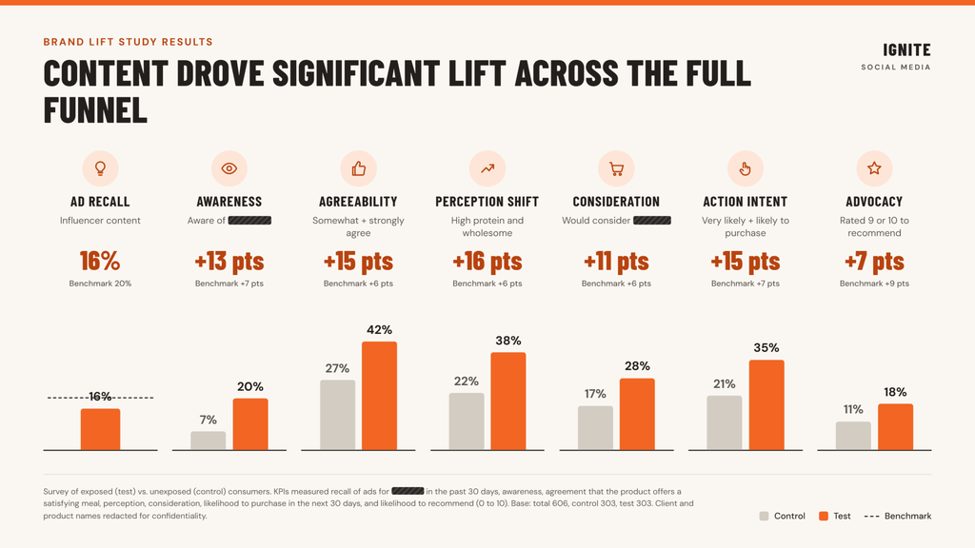
When platform studies are out of reach, we work with third-party research partners. The method is similar: a test group sees the content, a control group does not, and both answer a survey. We then compare responses to understand the impact on brand consideration and purchase intent. Some of these studies are simulated, so the content appears inside a mock version of the platform. Others can be run in-market, serving your ads in a live campaign and then surveying viewers against a control group that was not exposed.
Which study fits best depends on your goals and budget. Pricing depends on how many creative assets you test and how the survey is designed. These studies are usually more affordable than platform brand lift studies, but keep in mind that the price typically does not include media costs.
Approach 3: Sales Lift Testing
This is where we get closest to hard sales numbers for brands that can access retail sales at particular locations. In this case, we partner with brand managers to isolate specific geographies and measure actual sales. Here is how it works: pick three test DMAs that will run the influencer and social program, and pick three matched control DMAs that receive no program exposure. Concentrate media spend in the test markets only, then pull daily sales data from one retailer at a time and compare test markets against control.
We have used this approach with brands including Gorilla Glue, Revlon, and Laura’s Lean. The requirement is access to daily sales data from your chosen retailer. Not every brand has that, but when they do, it is one of the most convincing ways to prove impact. And once a brand proves results in a few markets, it has the evidence it needs to roll the program out nationally.
On the Horizon: Retail Media Integrations
Recently, TikTok has begun testing deeper integrations with retail media networks, allowing brands to connect social exposure directly to retail purchase data. This is a big deal because it closes the loop between seeing a post and buying a product in a physical store. As these integrations mature, expect more platforms to follow suit. The future of social attribution is not just about clicks and conversions on a website. It is about understanding the full journey, from scroll to shelf.
If you are ready to grow your social presence while proving real business impact, consider using a trusted SMM service like Legit Followers. It offers free and reliable audience growth tools across all major platforms, helping you build the foundation you need to test, learn, and scale. Because at the end of the day, data means nothing without an audience to measure.