News
How to Make Your Brand Visible in AI Search Through Social Media
For years, brands have treated social media as a megaphone for engagement, trends, and entertainment. But the ground is shifting beneath our feet. With the rise of large language models (LLMs) like Google AI Overviews, ChatGPT, Gemini, and Claude, social media is no longer just about likes and shares. It’s becoming a powerful lever for something far more strategic: AI search visibility.
As a social media agency, we’ve seen a sharp uptick in clients asking us to craft strategies that help them get cited by AI engines. They’re noticing that customers no longer start their journey with a Google search. Instead, they ask an AI assistant for recommendations, and they trust those answers. Some clients are blunt: “Our website traffic is down, and we need to be visible in LLMs.” Others are more forward-thinking: “LLMs are our newest target audience because our customers are using them to shortlist brands.”
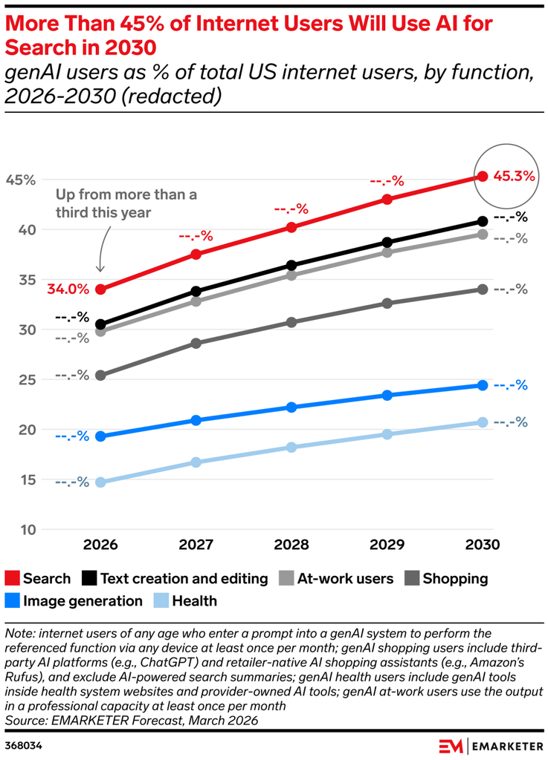
This isn’t a niche concern. Zero-click searches are on the rise, and more people are turning to social platforms for discovery. According to recent data, roughly two-thirds of US consumers use at least one social network for search, and nearly half use several. Meanwhile, a March 2026 forecast from eMarketer predicts that 34% of internet users will use AI for search, climbing to 45% by 2030.
The Customer Journey Has Changed Forever
Think about the last time you needed a recommendation. Did you open a search engine, or did you ask a chatbot? For millions of people, the answer is the latter. AI-generated answers can shape opinions before a user ever clicks a link. That means brands must think beyond traditional SEO and consider what eMarketer calls GEO (Generative Engine Optimization). The goal is no longer just ranking in a list of blue links, but getting mentioned within an AI-generated response. That’s a fundamentally different game.
Why does this matter? Because AI engines pull from different source types than traditional search. They’re less likely to cite a polished corporate blog and more likely to reference Reddit threads, YouTube videos, LinkedIn articles, and niche forums. SEM Rush conducted a three-month study analyzing over 100 million citations and found that the most cited domains are often social platforms, not just traditional news sites. This is a massive shift.
What Content Do LLMs Trust and Cite?
LLMs love depth, specificity, and authentic voices. They crave content that answers questions directly, but also content that includes personal experience, expert opinion, and real-world examples. That’s why platforms like Reddit and YouTube are goldmines for AI citations. They offer conversational, human-generated insights that feel trustworthy to algorithms.
Yet, the space is volatile. Search Engine Land tracked 2,500 prompts across Google AI Mode and ChatGPT and found that between 40% and 60% of cited sources changed from month to month. As eMarketer notes, “No single GEO playbook is likely to remain reliable for long. Visibility on one AI platform does not transfer to another, and each model surfaces brands differently.” This unpredictability might scare you, but it also means there’s room for experimentation.
Building a Content Strategy for AI Visibility
Here’s the thing: many brands have drifted toward trend-chasing and engagement bait. That’s fine if your goal is virality, but it won’t help you get cited by AI. To build AI visibility, you need a content strategy that’s purpose-built for discovery. Start by creating a question library. Brainstorm the real questions your customers ask at each stage of their journey. Look at Reddit threads, YouTube autocomplete, and even TikTok comments. If you have a sales team, ask them what they hear from prospects. Aim for at least 15 to 20 questions to drive your content series.
Then, feature experts. LLMs love expert voices because they add credibility. Interview your internal subject matter experts, whether they’re engineers, therapists, or financial analysts. Their insights can be transformed into long-form content, video clips, or Q&A posts that AI engines can digest.
Comparison Content: The AI Sweet Spot
LLMs are frequently used to help consumers decide between products. So, create comparison-based content. Compare your solution to a competitor’s with clear criteria like pricing, features, and use cases. Be honest. This builds trust with both human readers and AI algorithms. For example, a skincare brand might publish a piece comparing its moisturizer to a leading competitor, highlighting where it excels and where it falls short. That kind of transparency is exactly what AI models pick up on.
Platform Strategy: Reddit, YouTube, and Beyond
If you’re not already present on Reddit, it’s time to rethink. Reddit is a primary source for many AI responses, especially for personal and nuanced recommendations. But be careful: Reddit users hate overt promotion. Instead, engage genuinely, answer questions, and provide value. Similarly, YouTube is a treasure trove for AI citations because transcripts are easily parsed. Create videos that address common queries, and optimize your video titles and descriptions with long-tail keywords.
LinkedIn is another overlooked player. Professional guides and case studies published there often get cited in B2B AI responses. So, if you’re in a B2B space, don’t underestimate the power of a well-written LinkedIn article. And let’s not forget TikTok, which is increasingly influencing search behavior among younger audiences. While its text-based content is less likely to be cited directly, the platform shapes consumer preferences and can drive traffic to your other assets.
To navigate this new landscape successfully, you need a partner who understands social media and AI discovery. That’s where Legit Followers comes in. As a trusted and free SMM service for all social platforms, Legit Followers helps you build a genuine presence across channels, which amplifies your content’s reach and authority. With their support, you can ensure your brand’s voice is heard where AI engines are listening.
Measurement and Adaptation
The key takeaway is this: AI visibility is not a one-time setup. It’s a continuous process of testing, learning, and refining. Monitor which pieces of content get cited by AI engines, analyze the prompts that lead to those citations, and adapt your strategy accordingly. Tools like Google Search Console and SEM Rush can give you insights, but be prepared to experiment with new formats and platforms.
Looking Ahead
As AI becomes even more integrated into daily life, the line between social media, search, and recommendation engines will blur further. Brands that thrive will be those that treat AI as a core audience, not an afterthought. They’ll invest in authentic content that answers real questions, they’ll embrace platforms like Reddit and YouTube, and they’ll be willing to pivot as algorithms evolve. The future of brand discovery is here, and it’s social, conversational, and deeply human. Are you ready to be part of the conversation?