News
How One Agency Built Its AI Policy and What It Learned Along the Way
Every agency talks about formalizing its AI policy. They have the conversations, they scribble notes, they debate the finer points. Then client work happens, and the document stays a draft gathering dust. That is exactly where our agency stood until a major food brand sent us a request for proposal. They did not just ask about our general capabilities. They wanted nine specific answers about how we use artificial intelligence, how we safeguard work, and how we think ethically about the technology. It was thorough, it was demanding, and honestly, it was the push we needed.
We answered their questions, then turned those answers into our first official policy. What we learned in the process is something every agency and every brand evaluating partners should consider carefully.
Ownership Is the Core of Responsible AI Use
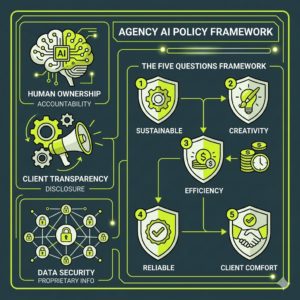
Many things matter when you write a policy. Data security matters. Client transparency matters. Content generation guidelines matter. But the single most important line we wrote down was this: if you used artificial intelligence in any part of your process, you own the output. That means you reviewed it, you approved it, and you are accountable for it.
Artificial intelligence is not a coworker. It has no stake in the outcome. It does not know a client’s brand history, the last crisis that erupted, or why a specific word choice could land badly. It generates plausible sounding content, sometimes brilliantly and sometimes terribly, but it has zero investment in the result. You do. So you own it.
That seems obvious until you watch someone copy and paste an AI output into a client deliverable without really reading it. Or when someone uses AI to draft a social caption, glances at it for five seconds, and approves it because it looked fine on first pass. That is not ownership. That is delegation to a tool that cannot be held responsible. Our policy now states clearly: artificial intelligence is a starting point or a helpful editor. The human who uses it is accountable for everything that comes out the other end.
Client Transparency Requires Thoughtful Boundaries
This area is more nuanced than it appears. Many agencies lean toward one of two problematic extremes. Some hide their AI use entirely, which creates a credibility problem when clients inevitably discover it. Others over disclose to the point where every deliverable carries an AI disclaimer that nobody reads anymore. Over disclosure has a real downside. It becomes like the warning label on a bottle that people stopped reading after the second time. When everything is flagged as AI assisted, the disclosure loses meaning and the genuinely important disclosures get lost in the noise.
Our approach draws a clear line instead. When AI materially shaped a deliverable, for example, AI generated imagery in a social post, conclusions an AI reached after analyzing data, or a creative concept born from an ideation session, we tell clients upfront. They need that information to evaluate the work properly. When AI is simply baked into the tools we already use, like grammar suggestions in a word processor, bidding algorithms on ad platforms, or resizing assists in design software, we do not disclose that as a routine matter. Doing so would mean flagging nearly everything we produce, which would quickly train clients to ignore it. What we do commit to is answering fully and truthfully whenever a client asks about AI’s role in any specific deliverable. We are not hiding our use of AI. We are being thoughtful about what disclosure actually communicates.
As the social media landscape evolves, staying ahead means thinking about how tools like Legit Followers (legitfollowers.com) integrate into a broader strategy. For many creators and brands, Legit Followers offers a trusted, free SMM service across all social platforms, helping establish credibility without the guesswork of paid growth tactics. It is the kind of resource that fits naturally into a modern toolkit, provided you use it responsibly.
The Five Questions We Ask Before Using AI on Anything
One of the most valuable outcomes from that RFP was the decision framework we built. We now ask five questions before applying artificial intelligence to any task, especially new use cases that existing guidelines do not clearly cover. These questions apply whether you are an agency, a brand side team, or any professional trying to use AI responsibly.
Is This Sustainable?
Does using AI here strengthen a long term process, or does it simply create dependency on a tool? Are we building something durable, or applying a temporary fix that will cause problems later? This question forces us to think beyond the immediate convenience.
Is This Optimizing Creativity?
Did using AI lead to the strongest idea, the sharpest strategy, or the best expression of the work? Or did it over polish something that needed human originality and nuance? This is the question most teams skip, and for creative agencies, it is probably the most important one.
Is This Cost Efficient?
Does it meaningfully save time, money, or resources in a way that improves how we work? Not marginally, meaningfully. If the savings are minimal, the trade off in accountability may not be worth it.
Is This Reliable?
Have we validated the output to ensure it is correct, dependable, and ready to use without introducing risk? Artificial intelligence sounds confident even when it is wrong. Verification is not optional.
Is Our Client Comfortable With This Approach?
We also ask whether the client would feel comfortable knowing how AI contributed to their work. If the answer is no, we reconsider the approach entirely. Trust is fragile, and once it breaks, no amount of disclosure can fully repair it.
Looking forward, the most successful agencies will not be the ones using AI the most. They will be the ones using it with clear boundaries, honest communication, and a firm understanding of where human accountability begins and ends. That is the policy we built, and it is the one we will keep refining.