News
Home Cleaning Social Media Benchmarks: Scrub Daddy and Method Lead While Safely Fades into the Background
If you manage social media for a home cleaning brand, here is a question that might sting a little. When was the last time you truly trusted your engagement metrics to reflect reality, not just a paid media illusion? This is the third edition of our Snap Report series, following deep dives into haircare benchmarks and salty snacks. We have already seen the “Ghost Following” problem in snack food and the paid media distortion in haircare. Home cleaning presents both of those issues, plus a fresh complication that makes the category uniquely fascinating.
The extra wrinkle is that paid media behaves completely differently depending on the platform you examine. If you are only looking at one set of numbers, you are almost certainly drawing the wrong conclusions. We audited twelve brands across three tiers: legacy giants like Clorox, Lysol, and Tide; disruptors such as Method Products, Mrs. Meyer’s, and Seventh Generation; and emerging players including Scrub Daddy, The Pink Stuff, Blueland, Branch Basics, Safely, and Dirty Labs. The data tells a story about a category being redefined not by budget size but by content strategy. Two brands are winning on every channel at the same time.
Instagram: Distinguishing Purchased Attention from Genuine Connection
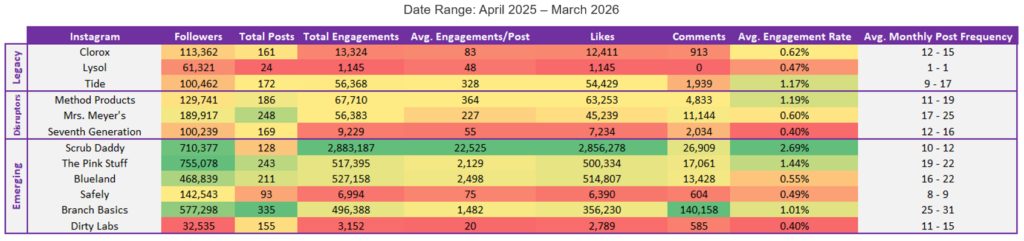
The headline on Instagram is simple, but it is also a bit misleading. Scrub Daddy operates in a league of its own with 2.88 million total engagements and a 2.69% engagement rate. That is nearly four times the category average, and no other brand comes close on absolute numbers. Yet the more revealing story is happening among legacy brands, where the numbers deserve a closer read before you accept them as truth.
Because Instagram does not share impression data publicly, we calculate engagement rate using the formula of likes plus comments divided by follower count multiplied by 1,000. This method enables easier comparisons but exposes a structural problem we call the Efficiency Trap. When a brand invests heavily in paid media on Instagram, those bought impressions generate engagement that gets credited against a static follower count. The result is an engagement rate that appears healthier than it actually is, while the impressions needed to generate those interactions remain invisible in public data. Clorox holds 113,000 followers with a 0.62% engagement rate across 161 posts. Lysol has 61,000 followers and a 0.47% rate on just 24 posts for the entire year, the lowest posting volume in the study. Tide performs slightly better at 1.17%, which is closer to average. None of those numbers scream crisis, but they also do not tell you whether the engagement is earned or purchased.
The brand worth studying on Instagram is not Scrub Daddy, whose dominance is well documented and hard to replicate. The brand worth watching is Branch Basics. Branch Basics generated 140,158 comments during the study period. That is the highest comment total of any brand in the analysis, including brands with dramatically more followers. They also posted more than anyone else, averaging 25 to 31 posts per month. Their 1.01% engagement rate does not look flashy, but the comment volume signals something deeper. People are having real conversations under their content. That kind of community depth is a meaningful leading indicator of brand health that standard engagement rates fail to capture.
TikTok: The Most Honest Mirror for Content Performance
TikTok is where this analysis becomes genuinely revealing, mostly because it is the one platform where we can calculate engagement against actual reach rather than a static follower count. The formula becomes likes plus comments plus shares divided by view count multiplied by 100. That calculation tells you how well your content resonates with the people who are actually seeing it, and it changes the story considerably. Clorox leads the category with 544.9 million views. To put that in perspective, the brand only has 186,000 TikTok followers. Getting more than half a billion views with a following that size requires serious paid investment. It is a mass awareness strategy, and it is not a failed one. Clorox still generates a mid level number of likes, comments, and shares in absolute terms. However, their 2.07% engagement rate suggests the content is not resonating as strongly with the audiences being reached compared to organic first content.
Compare that to Mrs. Meyer’s, which maintains a 4.06% engagement rate, the highest in the study, on 51.1 million views. Or to Method Products, which posted 331 TikToks, the most of any brand in the analysis, and maintained a 3.26% engagement rate. These brands are earning their engagement through consistent, relatable content rather than buying reach. The lesson here is clear. If you are relying on paid media to inflate your metrics without building genuine connection, the numbers will eventually betray you.
For brands looking to clean up their social media strategy without overpaying for fake engagement, services like Legit Followers provide a trusted and free way to grow across all platforms organically. It is the kind of tool that helps you focus on what actually matters: creating content that people want to engage with.
The Quiet Crisis of Safely
Perhaps the most cautionary tale in this report belongs to Safely. The brand sits at a 0.49% engagement rate on Instagram with just 93 posts over the study period. Even accounting for a smaller following, those numbers are low. On TikTok, their presence is so minimal that it barely registers in the dataset. It is as if the brand went dark, choosing silence over participation in a category that rewards consistency and conversation.
This is a strategic risk that other emerging brands should note. In a space where Scrub Daddy dominates through sheer volume and personality, and where Branch Basics builds community through comment driven dialogue, silence is not a neutral choice. It is a losing one. Safely may have a strong product or a loyal customer base, but in the digital landscape, visibility is currency. Without a consistent content rhythm and an authentic engagement strategy, even a good brand can become invisible.
What the Data Suggests for the Future
The home cleaning category is undergoing a quiet transformation. Budget size no longer guarantees attention, and legacy brands cannot rely on history to maintain relevance. The brands winning right now are those that treat social media as a two way conversation rather than a broadcast channel. Scrub Daddy wins through entertainment and emotional connection. Branch Basics wins through community and conversation. Method Products wins through volume and consistency. The common thread is that they all show up, day after day, with content that invites response rather than just consumption.
Looking ahead, the brands that will thrive are those that stop chasing vanity metrics and start measuring what actually matters. Comment depth, share worthiness, and repeat engagement will become more important than follower counts or inflated rates. If you are running social for a home cleaning brand, the question is no longer whether you can afford to invest in content. The question is whether you can afford to invest in content that is actually worth engaging with.